

Project
The Designer’s Best Assistant Tool
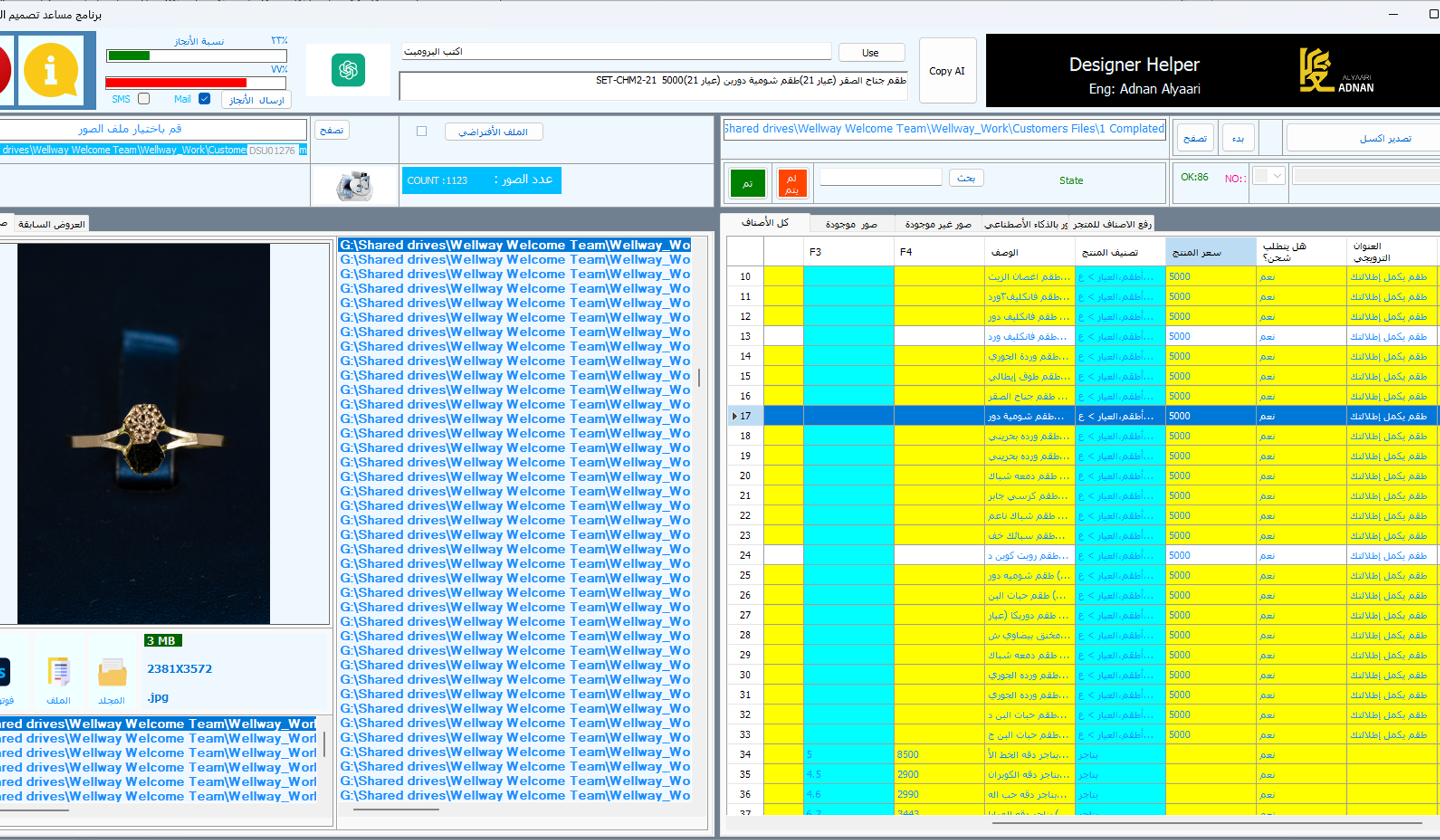
A desktop tool built for catalogue and promotional designers to organize thousands of products, images, and prices, track progress, and move efficiently between the application and Photoshop so they can focus on design rather than repetitive searching and manual coordination.
Problem
Catalogue and promotional design started with Excel files containing 2,000 to 3,000 products. Designers printed the data, handled each product individually, searched for prices and image locations or downloaded images from the internet, and manually tracked what had or had not been designed. Completing a catalogue in roughly 15 to 20 days became a major operational and creative challenge.
Goals
Organize the designer’s workflow by bringing product data, images, and prices into one place, clearly showing completed and pending items, and reducing time lost to searching and manual tracking so more effort can go into creative quality.
Solution
A desktop application was developed to manage promotions, images, products, and prices while tracking progress and preserving the designer’s stopping point. It shows completed and pending items, provides access to previous promotions for reuse in new designs, and supports an organized workflow with Photoshop. The solution also included an assistant for rapidly preparing and printing promotional shelf labels.
Process
- 01
Research & analysis
Understand the problem, workflow, and actual user needs.
- 02
Planning
Map the solution logic and select suitable tools and technologies.
- 03
Development
Build the features, process data, and connect system elements.
- 04
Testing
Validate functionality and results, then address feedback.
- 05
Launch
Prepare and deliver the solution for operational use.
Challenges
The main challenge was developing a software product outside the primary role while simultaneously managing the online store and marketing. This created substantial time pressure and required persistent learning, experimentation, and translation of a complex daily workflow into clear, executable application steps.
Results
The tool helped colleagues complete the work in roughly 4 to 5 days instead of around 20 days, gave management clearer visibility into progress, and preserved the work state and stopping point. According to the supplied project notes, execution time decreased by about 60%, while delivery speed, accuracy, catalogue design quality, and the designers’ day-to-day working experience improved.